AI can already answer most of the questions analysts get asked. That's not a threat to business analytics — it's a filter. It forces a sharper question: where does human judgment actually earn its keep?
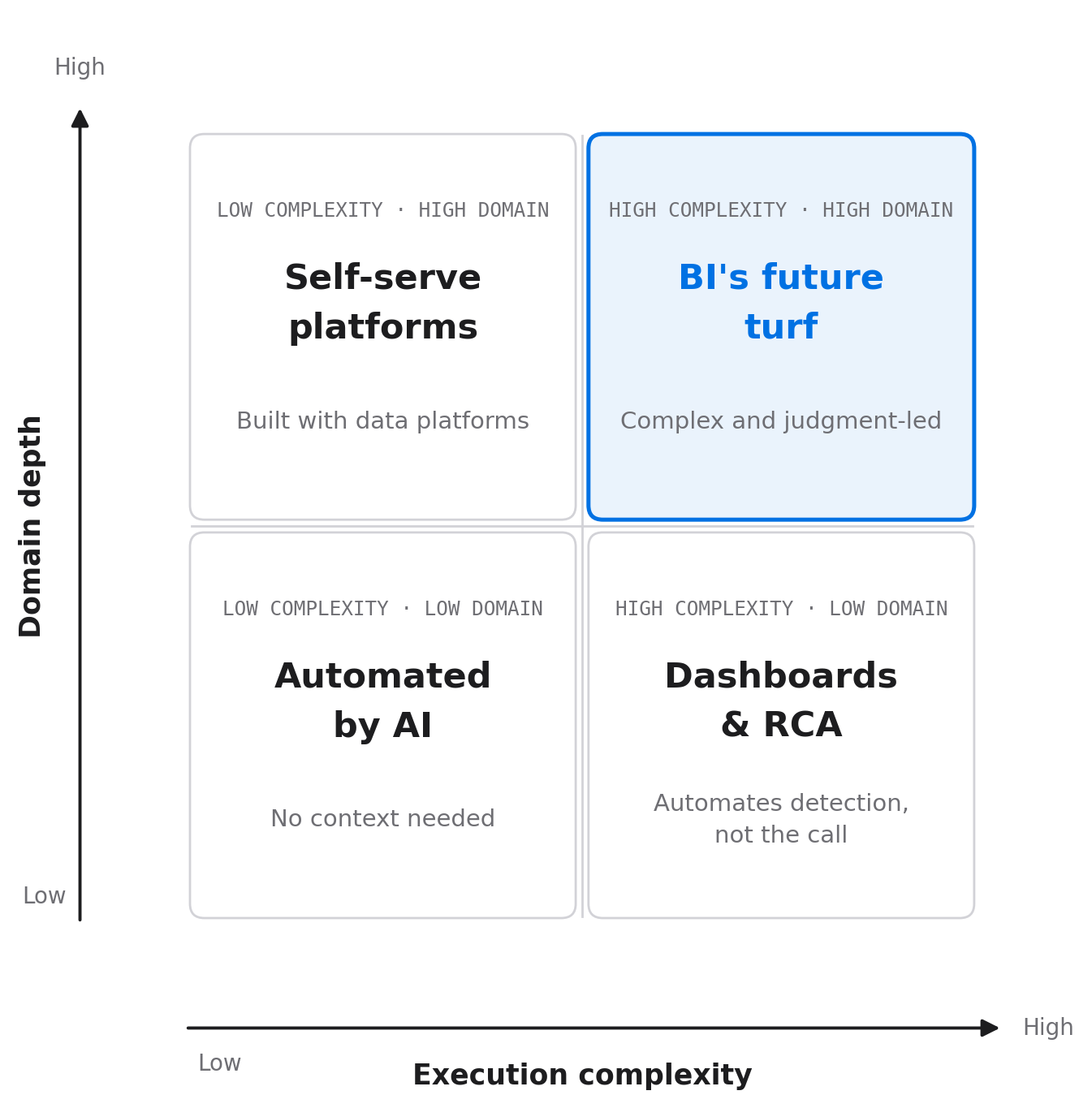
The way I think about it is a simple 2x2 — one axis for how technically complex the analysis is to execute, the other for how much domain depth it needs to get right.
Low complexity, low domain depth
AI handles this directly. No ambiguity, no context, no judgment call. If a model can do it end-to-end without understanding the business, it will — and BI shouldn't be defending that ground.
Low complexity, high domain depth
This is where BI's job shifts from answering to building. Partner with the data platform team to encode that domain knowledge into self-serve products — metrics layers, semantic models, natural-language interfaces — so the judgment is baked in once and reused infinitely.
High complexity, low domain depth
Automate the technical layer. Think multi-touch attribution, anomaly detection, statistical decomposition — work that's algorithmically hard but generalizable across businesses. BI should build the RCA flows that surface and narrow down candidate causes. Worth being honest here: this automates detection, not the final call — real root-cause conclusions still need someone who knows the business to validate them.
High complexity, high domain depth
This is where BI's future work concentrates. Pricing strategy under ambiguity, a new market's demand curve, the trade-off nobody's written a playbook for. AI shows up here too — as a research partner, a first-draft generator, a faster iterator — but the judgment stays human.
One honest caveat: this isn't a fixed map. As AI gets better, the boundary between quadrants moves — work that needs deep domain judgment today may not in two years. BI's job isn't to defend a quadrant. It's to keep moving toward wherever the frontier of judgment currently sits.
AI didn't make business analytics smaller. It just cleared out the part of the job that was never really the interesting part to begin with.